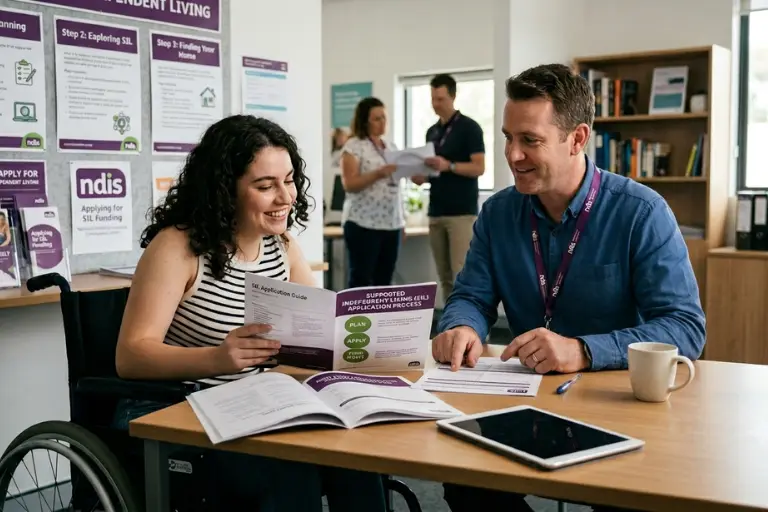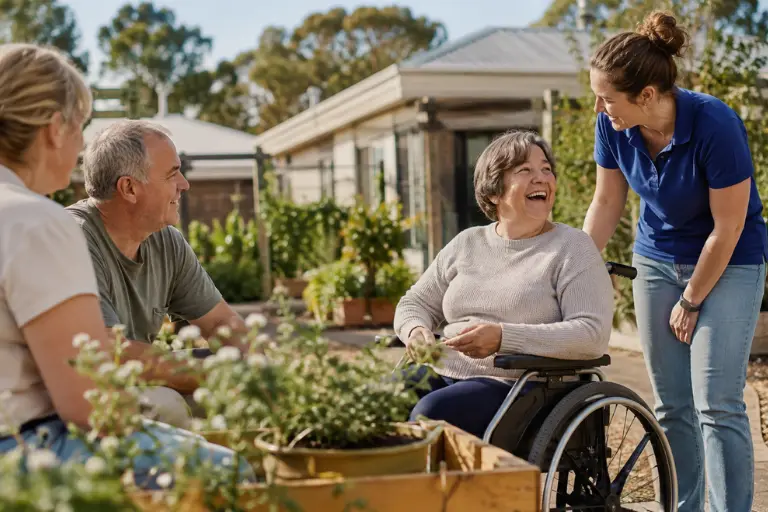
If you’re navigating an NDIS plan and want more independence, social connection or confidence in your local community, NDIS community participation support may help you access activities and build the skills you need to participate more independently.
Community participation can include support to attend social activities, join community groups, participate in recreation, develop travel skills, build confidence in unfamiliar environments and maintain relationships. Depending on your circumstances and NDIS plan, a support worker may assist you while you gradually develop the skills and confidence to participate more independently.
However, NDIS funding does not automatically cover every community activity or its associated costs. The support must relate to your disability, meet the relevant NDIS funding rules and be considered reasonable and necessary for your circumstances.
This guide explains what NDIS community participation means, what activities may be supported, how Core and Capacity Building funding can apply, current 2026–27 price limits, eligibility considerations and the changes being introduced from October 2026.
Quick answer: NDIS community participation supports can help eligible participants take part in social, recreational and community activities and develop greater independence. Depending on an individual’s plan and disability-related needs, funding may cover assistance from a support worker, community access and skill development. Ordinary activity costs, such as standard gym memberships or event tickets, are generally not NDIS-funded.
This guide was reviewed on 1 September 2026. NDIS rules, pricing arrangements and individual funding decisions can change, so always confirm current requirements with the NDIS or your plan representative.
What Is NDIS Community Participation?
NDIS community participation refers to supports that help people with disability participate in social, recreational, civic and community activities and develop greater independence.
For one participant, this could mean having a support worker accompany them while they learn to use public transport. For another, it could involve developing confidence to attend a community group, participate in sport, volunteer, attend a class or maintain relationships with friends.
The focus should be on the participant’s individual disability-related needs and goals, rather than simply paying for an activity.
Examples of community participation support may include:
- Attending a local sports or recreation group
- Joining a community or social group
- Participating in volunteering
- Learning to use public transport
- Developing confidence in unfamiliar community environments
- Accessing libraries, community centres and other public facilities
- Attending educational or skill-development activities
- Building communication and social participation skills
- Receiving assistance from a support worker during community activities
The NDIS assesses supports according to the participant’s individual circumstances. Having a goal relating to social connection or independence does not, by itself, guarantee that a particular support will be funded.
What Can NDIS Community Participation Fund?
The NDIS may fund disability-related support that helps you participate in the community where the support meets the applicable funding requirements.
The important distinction is between the support required because of your disability and the ordinary cost of participating in an activity.
For example, a participant may potentially receive support from a worker to attend a swimming session, while the ordinary membership cost of the swimming facility may not be funded.
Examples of potentially supportable activities
Depending on your plan and circumstances, community participation support may assist with:
- Sport and recreation: adaptive swimming, walking groups, sporting clubs and recreational activities
- Community groups: art groups, book clubs, men’s sheds and community organisations
- Learning and skills: cooking, art, music, digital skills and other relevant educational activities
- Volunteering: community gardens, charities, animal shelters and other community roles
- Travel training: learning public transport routes and developing independent travel skills
- Social connection: meeting friends, attending community events and participating in social activities
- Community access: accessing local facilities, services and activities that may otherwise be difficult to reach independently
The key consideration is whether the disability-related support is appropriate and meets the relevant NDIS requirements.
What Doesn’t NDIS Community Participation Usually Cover?
NDIS funding is not intended to pay for ordinary everyday expenses that people without disability would normally pay themselves.
Depending on the circumstances, this can include costs such as:
- Standard gym memberships
- Event or entertainment tickets
- The cost of meals
- Ordinary recreational fees
- General household or everyday living expenses
- Costs that are unrelated to a participant’s disability
For example, if a participant needs a support worker to accompany them to a community swimming session because of their disability-related support needs, the support worker’s assistance may potentially be funded. The participant’s ordinary swimming membership is a separate cost.
Always consider the specific circumstances and current NDIS guidance before assuming that a particular expense is funded.
Social Participation vs Community Participation: What’s the Difference?
The terms social participation and community participation are often used interchangeably when discussing disability support, although they can describe slightly different goals.
Social participation generally focuses on maintaining relationships, reducing isolation and taking part in social activities.
Community participation can have a broader focus, including involvement in community groups, recreation, volunteering, education, civic activities and skill development.
| Area | Social participation | Community participation |
| Main focus | Social connection and relationships | Broader involvement in community life |
| Examples | Meeting friends, social groups, shared activities | Sport, volunteering, classes, community groups |
| Possible outcome | Greater connection and reduced isolation | Greater independence, skills and community involvement |
| Support approach | Assistance to participate socially | Assistance, access and skill development |
In practice, the two can overlap. What matters most is how the support relates to your disability-related needs, goals and individual circumstances.
How NDIS Community Participation Is Funded
Community participation-related supports can appear across different NDIS support budgets, depending on the type of support and what is included in an individual participant’s plan.
Core Supports: Assistance with Social, Economic and Community Participation
Core Supports are designed to help participants with their day-to-day support needs.
For participants who also require broader assistance with personal routines and everyday activities, NDIS Assistance with Daily Life may provide support that is separate from community participation. The appropriate support depends on the participant’s individual needs, goals and plan.
The Core Supports category Assistance with Social, Economic and Community Participation can be used for eligible assistance that helps a participant participate in community and social activities.
Examples can include support worker assistance with:
- Attending community activities
- Participating in social groups
- Accessing recreation
- Developing community access skills
- Participating in activities outside the home
The exact supports available depend on the participant’s plan and applicable NDIS rules.
Capacity Building: Increased Social and Community Participation
Capacity Building supports have a different purpose.
Increased Social and Community Participation is intended to help participants develop skills and greater independence so they can participate more effectively in social and community settings.
Examples may include relevant skill development such as:
- Building social confidence
- Developing communication skills
- Learning community participation skills
- Developing independence in community settings
- Learning travel or transport-related skills
- Building skills that support participation in community activities
The distinction is important: Core Supports generally address assistance with participation, while Capacity Building can focus more strongly on developing skills and capacity.
Your plan determines which supports are available to you and how they can be used.
How Much Does NDIS Community Participation Cost in 2026?
NDIS providers must operate within the applicable NDIS Pricing Guide where price limits apply.
For 2026–27, the national price limits for standard assistance with social and community participation include the following indicative maximum rates:
| Support time | 2026–27 national price limit |
| Standard weekday daytime | $73.58/hour |
| Weekday evening | $81.07/hour |
| Saturday | $103.54/hour |
| Sunday | $133.50/hour |
| Public holiday | $163.46/hour |
These figures should be described as NDIS price limits, not mandatory provider charges. Providers and participants may negotiate an appropriate price where the NDIS rules allow it.
The applicable price can also vary depending on:
- The support type
- When the support is delivered
- Whether the support is individual or group-based
- The participant’s location
- Provider pricing arrangements
- Any applicable loading or additional pricing rules
Do group activities cost less per participant?
They can.
Where a support is delivered to multiple participants and the applicable NDIS rules allow shared support costs, the provider may claim the relevant proportion of the support cost for each participant.
The exact claiming arrangements depend on the support and pricing rules, so participants should check the current pricing arrangements rather than assuming that every group activity is divided in the same way.
Pricing changes periodically. Check the current NDIS Pricing Arrangements and Price Limits before making decisions about your support budget.
What Does an NDIS Support Worker Do During Community Participation?
A support worker should not simply act as a chaperone.
The purpose of community participation support can be to help a participant participate safely, build skills, develop confidence and increase independence.
Depending on the participant’s needs and funded supports, a support worker may provide:
Transport and mobility assistance
They may assist a participant to travel to and from a community activity or learn how to use public transport.
Skill development
This could involve practising practical skills such as:
- Reading a timetable
- Navigating a shopping centre
- Paying for an item
- Ordering at a café
- Planning a community outing
- Following a public transport route
Social and communication support
A support worker may help a participant:
- Enter unfamiliar social environments
- Communicate with others
- Use communication aids
- Develop confidence in group situations
- Build relationships and participate in community activities
Personal care during activities
Where personal care is part of the participant’s funded supports and relevant requirements are met, assistance may also be provided during community activities.
The objective should always be to provide the appropriate level of assistance while supporting the participant’s independence.
How Can Community Participation Build Independence?
Effective community participation support should have a purpose beyond simply filling support hours.
A strong support strategy may involve progressive skill development.
For example:
Stage 1: Support the participant to attend an unfamiliar activity.
Stage 2: Help the participant learn the route and develop confidence.
Stage 3: Reduce prompts and direct assistance.
Stage 4: Participant attends with minimal or no support where appropriate.
This type of progression can make the purpose of the support much clearer.
It also gives participants, providers and their support team a practical way to measure whether the support is contributing to their goals.
What Is NDIS Innovative Community Participation?
Innovative NDIS Community Participation is an NDIS support term that should not be confused with a general description of creative or unusual community activities.
Where this support is relevant to a participant, its use needs to be considered against the applicable NDIS support item, pricing arrangements and participant plan.
Examples of community-based skill development may include activities that help a participant develop practical skills, social confidence or greater participation in mainstream community settings.
Because support-item definitions and pricing can change, providers should check the current NDIS Support Catalogue and Pricing Arrangements and Price Limits before describing a particular activity as Innovative Community Participation.
Is NDIS Community Participation Funding Changing in October 2026?
Yes. The NDIS is introducing changes to how certain participant budgets are calculated.
From 1 October 2026, the NDIA is progressively resetting budgets for areas including social, civic and community participation and Capacity Building daily activities as plans are reassessed or renewed.
Importantly, this should not be interpreted as an automatic 50% reduction for every participant.
The effect on an individual participant depends on their circumstances, support needs and the outcome of their plan reassessment or renewal.
The transition is being introduced progressively rather than applying to every participant on one day.
What does this mean for participants?
If your plan is due for reassessment or renewal, it is sensible to:
- Review your current community participation goals.
- Identify the supports you actually need.
- Gather relevant evidence about your disability-related support needs.
- Document the outcomes you are working towards.
- Understand how your current supports contribute to independence and participation.
- Check the latest NDIS guidance before your planning discussion.
Do not assume that your existing budget will simply be reduced by a fixed percentage.
Your individual plan and circumstances remain important.
Need help preparing for a plan review?
A qualified support provider or support coordinator can help you document your goals, current support needs and progress so you can have a clearer discussion about your supports.
Am I Eligible for NDIS Community Participation Support?
There is no single rule that says everyone with a particular goal automatically qualifies for community participation funding.
The NDIS considers whether a requested support meets the applicable reasonable and necessary criteria and other funding requirements.
Relevant considerations can include whether the support:
- Relates to your disability
- Helps you pursue your NDIS goals
- Is effective and beneficial for your circumstances
- Represents value for money
- Is not more appropriately funded by another system or service
- Is not a support that should reasonably be provided by family, friends or the broader community
- Meets the other requirements that apply under NDIS legislation and policy
Having a goal such as “I want to be more social” can be a useful starting point, but a more specific explanation of what you want to achieve, why disability-related support is required and what outcome the support is expected to produce can make the request easier to understand.
How Do I Add Community Participation Support to My NDIS Plan?
If you believe NDIS community participation support is appropriate for your circumstances, prepare a clear explanation of what you need and why.
1. Define a specific goal
Instead of:
“I want to be more social.”
Consider a more specific goal such as:
“I want to develop the confidence and travel skills to attend a local swimming group independently twice a week.”
The goal should accurately reflect your circumstances rather than simply being written to obtain funding.
2. Explain the disability-related need
Describe what prevents you from participating independently.
For example:
- Difficulty navigating unfamiliar environments
- Mobility limitations
- Communication barriers
- Difficulty managing social situations
- Safety-related support needs
- Difficulty using public transport independently
3. Gather relevant evidence
Where appropriate, evidence from professionals involved in your support may help explain your functional needs.
Depending on your circumstances, this could include information from:
- Occupational therapists
- Support coordinators
- Allied health professionals
- Existing disability support providers
Evidence should explain why the support is required and what outcome it is intended to achieve, rather than simply stating that a participant wants more hours.
4. Explain the expected outcome
Show how the support could contribute to a measurable outcome.
For example:
Current situation: Participant cannot independently travel to a weekly community activity.
Support: Structured transport and community access assistance.
Skill development: Learning the route and practising independent travel.
Expected outcome: Participant can eventually attend the activity with reduced assistance.
This provides a clearer connection between the requested support, the participant’s needs and the intended outcome.
A Practical Example of Community Participation Planning
Consider an illustrative example involving a participant named Josh.
Josh wants to join a local basketball team but has difficulty using public transport independently and feels uncomfortable entering unfamiliar group environments.
Rather than describing the request simply as “social support”, his support strategy could identify:
- The community activity he wants to attend
- The barriers created by his disability
- The assistance he requires
- The skills he wants to develop
- How progress will be measured
- Whether the level of support can reduce as his independence increases
For example, his initial support might involve assistance with the journey to training and entering the venue. Over time, the focus could shift towards independently completing the journey and participating with less direct assistance.
This is an illustrative example, not a guarantee that the NDIS will approve a particular support or funding arrangement.
The important principle is to connect the support request to the participant’s actual circumstances, disability-related needs and goals.
How to Make Community Participation Support More Effective
The most useful community participation plans focus on outcomes rather than hours alone.
Before starting or reviewing your support, consider:
- What do I want to do independently?
- What currently prevents me from doing it?
- What disability-related support do I need?
- What skills can I develop?
- How will I measure progress?
- Can the level of assistance change as my skills improve?
- What relationships or community connections am I trying to build?
This approach can help turn community participation from a schedule of activities into a structured pathway towards greater independence.
Why the Right Community Participation Support Matters
NDIS Community participation should be about more than filling time.
The right support can help a participant develop confidence, strengthen relationships, learn practical skills and become more independent in everyday community life.
At AAYDS®, we take an individualised approach to disability support. As a registered, family-owned NDIS provider based in Moreton Bay, Queensland, we work alongside participants to understand their goals and develop support that reflects their individual circumstances.
Our community participation services support participants across:
- Moreton Bay
- Morayfield
- Narangba
- Caboolture
- North Lakes
Whether you want to build confidence in your local community, develop independent travel skills, participate in recreation or connect with community groups, our team can discuss the support options that may be appropriate for you.

Allison Cosgrove
Hi, I'm Allison Cosgrove, Founder and Director of AAYDS (All About You Disability Support). I have over 15 years of experience in disability support and hold a Diploma in Individual Support. I'm passionate about helping NDIS participants, families, and carers access personalised, high-quality support that promotes independence and wellbeing.